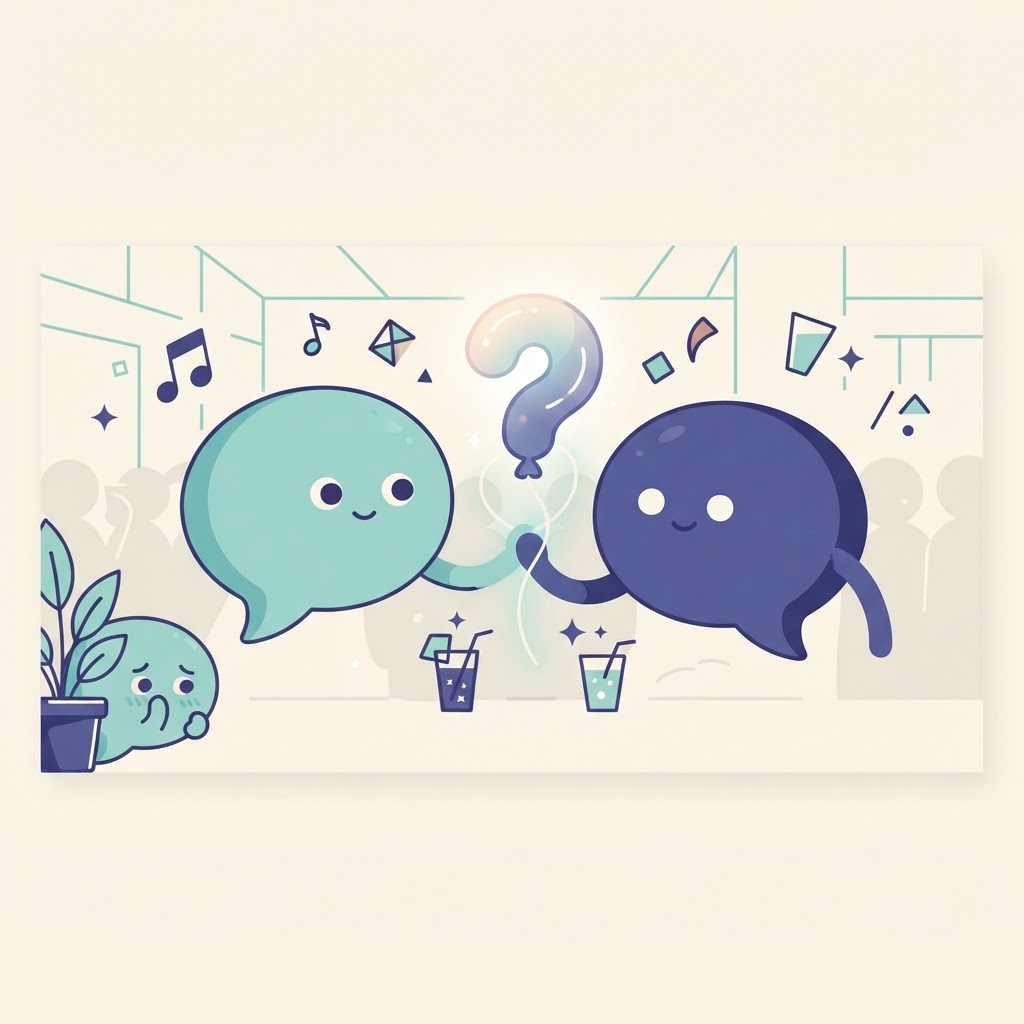
Conversation Starters That Actually Work (For People Who Hate Small Talk)
You're at a party, holding a drink you don't want, next to a stranger, and your brain has presented you with exactly three options: "How about this weather," "So... come here often?", and a slow, dignified exit toward the snack table.
Here's the thing: it's not you. It's the starters. "How about this weather" fails not because you're boring but because it's a closed question with one obvious answer, and you both know it. Good conversation starters aren't about being clever — they're about opening a door the other person actually wants to walk through. This guide gives you the mechanics, the word-for-word openers, and how to keep a conversation going after the first sentence — because a starter is only as good as its second line.
Why Most Conversation Starters Fail
A bad starter does one of three things:
- It can be answered in one word. "Having fun?" — "Yep." Congratulations, the conversation is over and it never began.
- It's a disguised interview question. "What do you do?" is where every conversation goes to become small talk. It's fine as an exit ramp; it's terrible as an entrance.
- It's about logistics instead of the person. Weather is a fact neither of you controls. People light up about things they choose, not things that happen to them.
The fix for all three is the same: ask about opinions, stories, and specifics instead of facts.
The Two Rules That Change Everything
- The Two-Question Rule. Never ask one question and stop — the first question finds the topic, the second question is the actual conversation. "Have you been to one of these before?" is a starter; "Oh, you know the host from college? What was she like?" is a conversation.
- Answer, then ask. If you ask a question, be ready to share your own answer first. "I'm a hide-by-the-snacks person at these things — I station myself there for twenty minutes before I talk to anyone. What's your strategy?" Vulnerability first, question second. It works at every party on earth.
And when in doubt, borrow a journalist's trick: follow up on whatever they just said. People hand you conversational threads constantly; most of us step over them on the way to our next prepared question.
Conversation Starters by Setting (Word for Word)
At a party:
- "How do you know the host?" (The classic, because everyone has a story and stories go somewhere.)
- "Okay, important question: snacks table or bar — which one are you stationed at?"
- "What's the best thing that happened to you this week?"
- "I'm trying to decide if that playlist is bold or a crime. What's your read?"
At work:
- "What are you actually working on these days?" ("How's work" gets "busy." This gets a real answer.)
- "What's something you're looking forward to this month?"
- "I need a new podcast/show/book — what's been keeping you sane lately?"
- "How long have you been at the company? Has it always been like this?" (Asked warmly, this one builds alliances.)
On a first date (or a dating app moving to a call):
- "What's the thing you could talk about for an hour with zero preparation?"
- "What does your ideal Saturday look like, start to finish?"
- "What's a strong opinion you hold about something completely unimportant?"
In a group where you know nobody:
- "What's your connection to all this?"
- "What's everyone's verdict on [the food, the venue, the event]?"
- "I'm doing the rounds — who's the most interesting person you've met tonight?"
For more on the dating-app version of this, see our guide to responding to "hey" and restarting stalled conversations.
How to Keep a Conversation Going After You Start It
The starter is the door; these are the hallway:
- Follow-up questions beat new questions. "You said you just got back from Portugal — what was the highlight?" beats pivoting to something unrelated. Depth feels like connection; topic-jumping feels like an interview.
- Use their words. If they say "I'm obsessed with my dog," the next sentence writes itself. People flag their interests constantly — the skill is noticing the flag.
- Share, don't interrogate. A conversation is two people taking turns being interesting. After two questions, offer something of your own.
- Let silence do some work. A beat of quiet isn't failure — it's often where the real thought enters. Frantically filling every gap is what makes conversations feel like dodgeball.
Conversation Starters for Shy People (The Honest Section)
If small talk makes you want to dissolve, don't memorize more questions — lower the stakes instead:
- The reaction starter: "That looks good — have you tried it?" (It's about the food, not about you. Perfect training wheels.)
- The compliment starter: "Those are great glasses — where'd you get them?" (Everyone likes a specific compliment, and specificity says you noticed, which says you're kind.)
- The honest opener: "I don't know a single person here, so I'm starting with you." (Frightening, disarming, and weirdly effective — honesty is the most underused starter there is.)
- Remember the math. Most people at most events are also quietly hoping someone talks to them first. You're not the only one at that party performing normalcy; you're just the one who did something about it.
The delivery matters as much as the words — for calibration, see our guide to choosing the right tone for any message.
What NOT to Open With
- "How are you?" (It's not a question; it's a greeting. It produces "good, you?" 100% of the time.)
- "What do you do?" as your very first move (Save it for minute four, when it becomes a real question about a real person.)
- Anything you'd resent answering. Income, politics, kids, "why are you single" — if it's not small talk, don't open with it.
- A compliment about their body. Compliment choices, not genetics.
The Real Secret
Nobody remembers your opening line. They remember how they felt talking to you — whether you asked, listened, and followed up. The starter is 10% of the conversation; the interest is the other 90%. For the habits that carry the rest of any conversation, see our guide to sounding smarter in any conversation. And when it's time to close the loop gracefully, see how to end a conversation politely.
Never Freeze at a Party Again
Knowing the starters is step one; having them at the ready when your brain goes blank is the hard part. That's where Sound Smarter comes in: tell it the situation — a networking event, a first date, a party where you know nobody — and get openers and replies tuned to the moment and your tone.
Get your conversation starters from Sound Smarter — free to try, no snack-table hiding required.