The Real Apology: How to Say Sorry and Mean It
You did a thing. You know you did the thing. And now you're rehearsing an apology in the shower that somehow contains three "I'm sorry"s, two excuses, one "but honestly," and a request for immediate forgiveness with a full pardon and a certificate of innocence.
That's not an apology. That's a hostage negotiation where the hostage is your guilt.
Here's the anatomy of a real apology — what to say, what to never say, and word-for-word scripts for the situations where you actually need one. (And to be clear: this is about apologizing for real harm. If you're apologizing for existing — "sorry to bother you," "sorry, quick question" — that's a different problem, and we wrote that guide too. Link at the bottom.)
The four parts of a real apology
A real apology has four parts. Skip any one of them and the whole thing collapses like a bad soufflé:
- Name the thing. Specifically. "I'm sorry I said that" is vague. "I'm sorry I made that joke about your job in front of everyone" is an apology. Specificity is proof that you actually know what you did.
- Own it. No "but." "I'm sorry, but I was really tired" means "here is my excuse, please file it under sorry." The word "but" deletes everything before it. Every time.
- Acknowledge the impact. Their feelings are the bill, and you're paying it. "I know it embarrassed you, and that's on me." You're not arguing with the receipt — you're paying it.
- Say what changes. An apology without a change plan is a promise to do it again with better lighting. "Next time I'll tell you directly instead of venting to the group chat."
Optional fifth part, and it's a big one: let them respond without demanding absolution. "I understand if you need some time" is graceful. "So are we good now?" is an invoice.
Scripts for the situations where you actually need one
To a friend you wronged
- "I owe you an apology. I told Maya what you told me in confidence, and that was a real breach of trust. I know it put you in an awkward spot. I won't share anything you tell me again — and I get it if you're careful with me for a while."
To a partner
- "I'm sorry for how I talked to you last night. It was harsh and unfair, and I could see it hurt you. I'm going to work on not taking my stress out on you. Can we talk more when you're ready?"
- What you're not doing: "I'm sorry, but you know how I get when I'm hungry." Being hungry is not a defense attorney.
To a coworker
- "I want to apologize for how I handled the meeting. I interrupted your section and re-explained your point as if it were mine. That was wrong, and I should have let you run with it. I've asked to add a credit note in the follow-up, and it won't happen again."
By text (when it can't wait, keep it short)
- "Hey — I owe you an apology for what I said last night. It was out of line, and I'm sorry. Can I call you tomorrow?" Full stop. No emoji softeners, no "lol," no joke at the end to take the edge off. The edge is the point.
When you genuinely don't know what you did
- "I have the sense I upset you, and I want to understand it. Can you tell me what happened? I'm not asking to defend myself — I just want to get it."
- Then actually listen. Do not use their explanation as a launching pad for "well, technically."
When the apology is long overdue
- "This should have been said a long time ago, and I'm sorry for the wait on top of everything else. What I did at your birthday was selfish, and I've thought about it a lot. I don't expect it to fix anything — I just wanted you to know I know."
The Non-Apology Hall of Fame (retire these forever)
- "I'm sorry you feel that way." The undisputed champion. You've apologized for their feelings existing, not for your actions. This isn't an apology — it's a customer service form letter with eye contact.
- "I'm sorry IF I hurt you." The "if" is doing so much work. You're not sure they got hurt? By the thing you did? You are. You are sure. You're just dodging.
- "I'm sorry, but—" See above. The "but" is a shredder.
- "Anyone would have done the same." Then apologize the way anyone would have.
- The joke apology. "I'm a disaster, LOL, anyway—" Humor is a fire door out of the uncomfortable room. Stay in the room.
- The gift apology. Flowers are lovely. They are also not words. Unless a card with a full four-part apology is attached, the flowers are a bribe with petals.
- "I already SAID sorry." Repeated at increasing volume. An apology is an offer, not a debt collection. They don't owe you acceptance on your timeline.
- The apology tour. Apologizing to everyone in your shared friend group so they all tell the person you feel really bad. That's reputation management, not amends.
What to do after you apologize
The apology is the down payment. The proof is the follow-through:
- If you said you'd stop doing the thing — the proof is the stopping.
- If they need time — give it without sulking visibly from a nearby location.
- If they accept and forgive — don't immediately ask for restoration of all pre-mistake friendship privileges. Let the account refill.
And when they eventually tell you "it's fine" before it's actually fine — don't cash that check early. "Thank you for saying that — I'm still going to make sure I don't repeat it" is how you close a loop without pretending it closed.
One last thing: apology is a skill, not a confession of being terrible
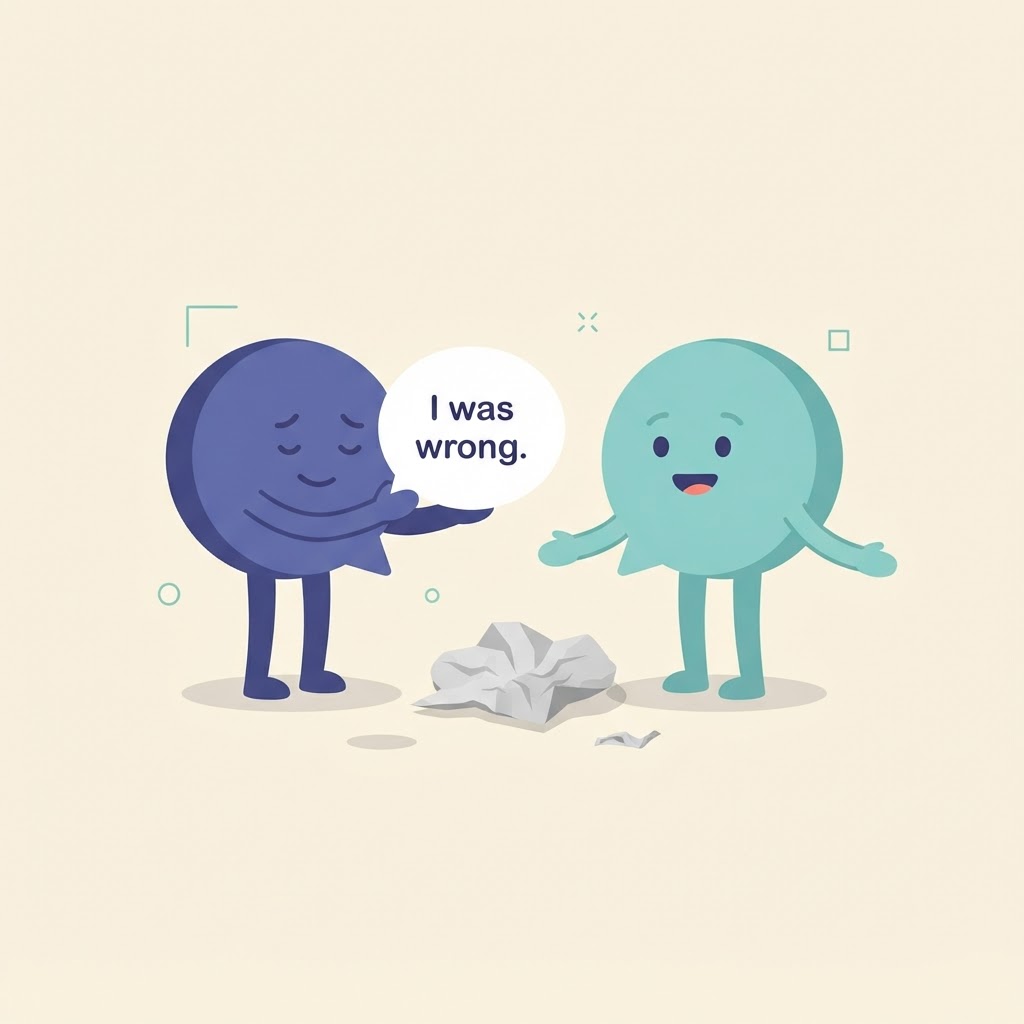
Saying "I was wrong" out loud feels like handing someone a weapon. In reality, it's one of the most disarming things a person can say. People trust the ones who can repair. A person who apologizes well isn't revealing weakness — they're demonstrating that they can be trusted to notice damage and fix it. That's rarer than never messing up, and worth infinitely more.
Related reading:
- This is the sequel to our guide on the OTHER apology problem — apologizing for existing when you've done nothing wrong: How to Stop Saying Sorry (And What to Say Instead): https://www.soundsmarter.app/blog/what-to-say-instead-of-sorry
- For the general foundation — small words, clearly said — start with the pillar guide: https://www.soundsmarter.app/blog/how-to-sound-smarter-in-any-conversation
- And for the other side of a hard moment — receiving something gracefully instead of dodging it: How to Accept a Compliment (Without Deflecting): https://www.soundsmarter.app/blog/how-to-accept-a-compliment
Closing CTA: Need help wording the hard ones? Paste your apology into Sound Smarter and we'll help you say it clean — no "but," no "if," no flowers required. https://www.soundsmarter.app